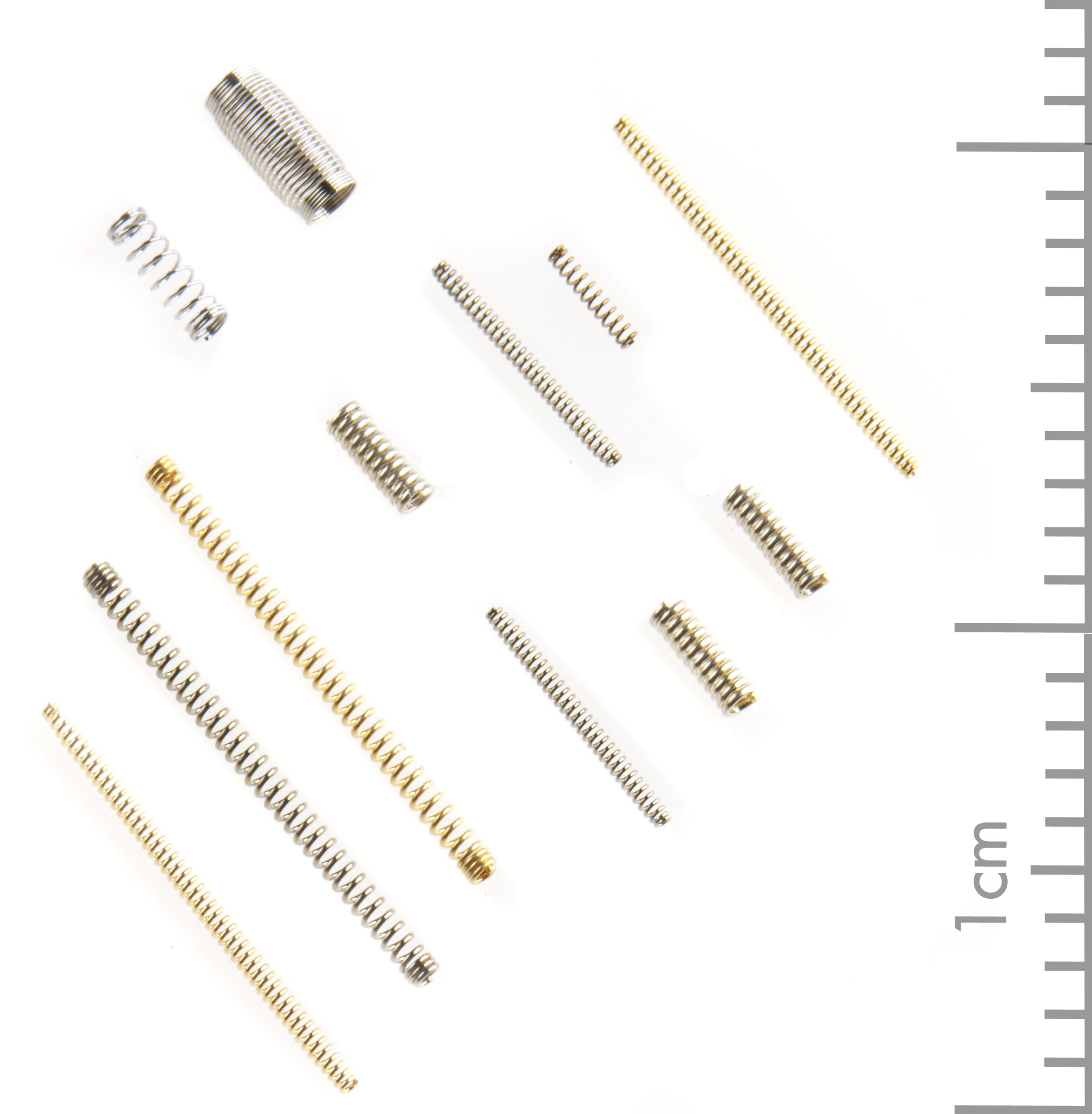
Miniature compression springs are among the most specification-sensitive components in any electronics assembly.
At HyTech, we regularly manufacture custom springs with wire diameters measured in thousandths of an inch, spring rates that must remain consistent across millions of cycles, and free length tolerances that leave almost no room for variation. All of that is to say, these parts are far more challenging to manufacture reliably than their size and seemingly simple design suggests.
For product designers and engineers working in electronics, the spring is rarely the centerpiece of a design. Nevertheless, getting these precision mechanical parts correct is absolutely essential to the functional performance and reliability of the end product.
Take these three scenarios for example:
- A battery contact spring with inconsistent load force introduces resistance variation.
- A button return spring outside of rate tolerance changes tactile feedback in ways users notice immediately.
- A probe pin spring that fatigues prematurely creates test failures that mask themselves as board-level defects.
Poorly specified springs, or ones manufactured to subpar quality, can create those and a myriad of other issues. For miniature springs used in modern electronics, precision and repeatability are prerequisites for successful end products. At HyTech, we never compromise on either.
Material and Process Considerations for Electronics Applications
Material selection at the miniature scale deserves more attention than it sometimes receives during early design stages.
Music wire remains a cost-effective choice for many interior assemblies where corrosion exposure is controlled, but 302 and 316 stainless steel alloys are typically the better default for electronics applications given their corrosion resistance and stable modulus of elasticity across operating temperature ranges.
For a more in-depth look at material options, see our previous article: Choosing the Right Wire Forming Material
When the spring must conduct current or operate in a magnetically sensitive environment, phosphor bronze and beryllium copper become the appropriate specifications, offering the conductivity and non-magnetic properties that steel cannot provide.
Surface condition is another variable that matters more in electronics than in many other industries. Burr-free ends, consistent coil geometry, and cleanliness requirements are not optional considerations for components going into precision contact assemblies or automated insertion processes. Our manufacturing process typically treats these as baseline expectations.
Where Miniature Compression Springs Appear in Electronics Assemblies:
- Battery and charging contacts in handheld devices, wireless audio products, hearing aids, and wearables where consistent contact force directly affects power delivery reliability
- PCB test sockets and spring-loaded probe pins where cycle life, contact resistance, and positional accuracy determine test yield
- Tactile switch and keyboard mechanisms where spring rate and solid height define the actuation feel that product teams spend significant time tuning
- SIM, microSD, and connector ejection mechanisms where spring geometry must fit within extremely constrained envelope dimensions
- Board-to-board and flex-to-rigid connector assemblies where compression springs compensate for stack-up tolerances and maintain contact force under vibration
- Camera autofocus and optical image stabilization assemblies where spring rate uniformity directly influences actuator behavior and image quality.
- Wearable device crowns, side buttons, and haptic feedback mechanisms where miniaturization requirements push spring dimensions to their practical limits.
- Portable medical diagnostic devices including glucose meters, pulse oximeters, and handheld monitoring equipment where spring reliability is tied to patient-facing performance.
Working With HyTech on Miniature Spring Development
The most productive engagements we have with engineering teams happen early in the design process, when material selection, end condition geometry, and tolerance stack-up can still be addressed before tooling is committed.
We work from customer prints and specifications, and we actively flag manufacturability concerns that could affect yield or long-term consistency before they become production problems.
HyTech Spring & Machine supports both prototype quantities for design validation and production volumes for qualified programs. If your team is specifying miniature compression springs for an electronics application and wants a manufacturer who can engage at an engineering level, we are ready to review your requirements and get the conversation started.